Showing posts with label advertising. Show all posts

November 16, 2007

Viral Marketing: The Rant.

Viral, shmiral. IF I HAVE one more would-be client tell me they’re looking for a “viral marketing” campaign... I’ll scream! (And I guarantee that the video of my screaming will result in a higher social network potential than 90% of the products or services that I’ve been approached to virally market!)

Let’s get a few things straight: just because FACEBOOK.COM and YOUTUBE.COM did it, just because the Blair Witch Project did it, does not – repeat – does not mean that you can do it. Or should, for that matter.

What is viral marketing? It’s a marketing strategy/tactic that focuses on social networks to boost brand awareness. For all intents and purposes, it means: word of mouth. One person sees an interesting thing and tells another and another and another. It is based on the belief that a satisfied consumer will express their satisfaction to an average of three others. (NOTE: there is also the belief that a dissatisfied consumer will express their dissatisfaction to an average of eleven others, so better hope your viral marketing campaign doesn't go wrong.)

Would-be clients that ask me for viral marketing campaigns have little understanding of the dynamics of such campaigns. What they really want is low cost; somehow there is the assumption that viral marketing campaigns are inexpensive. But this is simply not true. YouTube.com, for example, invested more than $10 million to achieve its success – and, as anybody can see from their site, it wasn’t all spent on software development!

Here’s a few things you should know about viral marketing campaigns…

First, they are rarely successful in B2B marketing. The reason is that the decision makers don’t commiserate in the way that end consumers do.

Second, you might notice that most highly successful viral marketing wunderkind – like YouTube, or Digg, or Facebook – offer their services for free.

Third, the money you hope to save in paid advertising is likely going to be spent on the market research necessary to find a high coefficient of social networking potential – in other words, finding an audience that will actually behave virally with your product or service.

Fourth, a lot of viral marketing is really better known as “astroturfing” – that is, it’s formal and structured marketing or PR campaigns disguised to look like grassroots reactions. It’s call astroturfing because it’s fake grassroots. It’s a technique borrowed from the political arena (e.g. it would be like the AMA flooding the U.S. Internet community with emails allegedly from people in Canada, talking about how bad their healthcare coverage is.)

Bottom Line: Get over it. If you really have the kind of budget to engage in a real viral marketing campaign come talk to me. If you're just looking to do marketing cheap, think again – viral marketing isn’t the way you’re going to do it.

Alternate Strategy: Think in terms of 'word of mouth' marketing. Not the verbal kind of viral marketing but rather the old-fashioned kind -- the kind where you produce such an excellent product or service that your clients feel compelled to tell their associates.


Click KLynn Business Consultants to link to the KLynn consulting site.

September 1, 2006

The Rule of List, Offer & Presentation

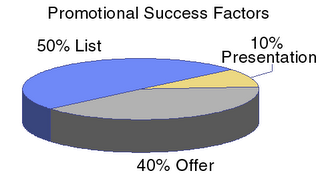
There are few marketing tenets more important than that of "Lynn's Rule of List, Offer, and Presentation"*. Essentially what this rule governs is the success factors in marketing communications -- where "success" is a measure of how much response there is to an advertisement or promotion. The rule suggests that selecting the right "list" (i.e. your audience) contributes 50% of the success of any given advertisement or promotion, and 40% comes from having the right "offer". The remaining 10% comes from the "presentation" or the creative component of the advertisement or promotion.

Think about it... if the rule holds true, what this suggests is that all the money spent on impressive graphics and clever copywriting contributes only 10% to the success of an advertisement or promotion. Scary.


So let's look at where the 90% comes from. The rule suggests that 50% is attributed to the "List". For a mailing, it's the mailing list, for a print ad, it's the circulation list, for an event, it's the attendees list, and so on. The promotional quality of the list is what's important. In the case of lists, quality is determined by the relevance of the members of the list to the promotion being made. Are they in the target marketplace? Are they decision makers? Is there evidence that they respond to this type of promotion? How long ago? These are all questions important in selecting a list. For example, the notion of advertising in a magazine without understanding the circulation list or exhibiting in an event without understanding the attendees is essentially promoting "blind" and the results are likely to be underwhelming.

The list is a significant component of promotional success, but where many marketers go wrong is failing to make an "offer" to the list. They may create a beautiful and clever print ad, they may place it in a magazine with an appropriate circulation list, but they fail to offer the prospective viewer any reason to act. In effect, an ad without an offer is like me introducing myself to someone I've been dying to meet, and then saying only "Hi, my name is Kurt" and then walking away. What's the point?

An offer is an invitation to act -- a call to action. An offer can be as simple as "Buy GeeWhiz today!" or as complex as "Buy GeeWhiz at 20% off, while supplies last, one to a customer; offer expires September 30, 2006". Some offers work betters than others but any offer works better than none at all.

There is both science and art to making a compelling offer that will evoke a good response from a list of prospects. The science of good offers has been developed through years of empirical testing -- principally through "split-testing" of different offers (sending one offer to group A and another to group B and statistically comparing results). Testing in this way has proven that different offers have different strengths. For example, a sample list of offers is shown below, in order, from strongest to weakest:

  • "Sweepstakes" or contests (e.g. "Win $2,500 cash and a trip to Costa Rica...")
  • FREE!
  • 25% Off!
  • No Risk, Money Back Guarantee.
  • Limited time or quantity (e.g. "Offer good only until ..." or "Only 100 available!"
  • Send for information.
  • Have a salesperson call.

The art of good offers is how we package the science. For example, "50% off", "Save $100 each", and "Buy one, get one FREE!" are financially equivalent for a product with a $200 SRP --but each evokes different buying dynamics. Likewise, "Call 800-555-11111 for installation details" is essentially the same as "Call 800-555-1111 for your FREE planning guide".

With offers, it's also a good idea to keep in mind the effect of a strong offer on your entire sales cycle. A strong offer may result in an excellent response rate to your promotion. But the leads that are generated by it may be more difficult to close or have a low closing percentage. For example, a compelling offer in an advertisement for network management tools might be "Ask for our FREE planning guide and we'll send you a check for $25!" Almost certainly you'll be asked for many planning guides... but the close rate on prospects generated in this way will be low. Why? The responder wants the $25, not the guide or product. On the other hand, with an offer of a rebate of $25, the offer associates the incentive with the desired action -- i.e. you get the $25 when you buy. The response rate will be lower, but the quality of the lead will be higher.

Bottom Line

Make sure all your promotional work is vetted against the rule of List, Offer, and Presentation. Check each element to ensure that your promotion is focused on the right audience, includes a compelling (to the audience) offer, and is presented in a way that will make the offer stand out.


Click KLynn Business Consultants to link to the KLynn consulting site.


*This rule of thumb is actually industry legend in the direct marketing world. I only claim it as my own because so few people actually practice it.